Kilo
Kilo
Dates
Dates have become an exquisite product of Spanish gastronomy. Some of our great masters of cuisine: Berasategui (see Martín Berasategui and dates), Aduriz, Ruscalleda, Roca, Dacosta..., among others, are increasingly using it in their most recognized textures and flavors.
Fresh dates
I would start by stressing very clearly that what everyone knows as dates (without exception, I would dare to say), is to fresh dates what grapes are to table grapes, that is to say, very little or almost nothing.
The date season is from October to January. This is when the harvest takes place and only then when fresh dates can be found; however, dates freeze excellently, due to their high concentration of sugars. This allows the cook to stock up in season, freeze (-20ºC) and then consume them the rest of the year "on demand". It is best to thaw them cold (refrigerator), in 2 or 3 hours. The thawed date loses, as it is logical, part of its crunchy texture but on the other hand it loses very little flavor and it is much more useful for the cook who has to cut, chop or grind it...
It should be made clear that the fresh date is a product that, if not properly treated after harvesting, is highly perishable. Its high sugar content (almost 50% of its weight when fresh), together with an ambient temperature of 20 to 25ºC, favors the fermentation of these sugars in a few hours.
It is for this reason that the date that arrives to us from Africa is a semi-dried or dehydrated date or at most candied in sugar. Lately another larger frozen date has been arriving in the fruit shops; this one comes from Israel, but it does not have much to do with ours either, it is very apparent but very cloying and not very aromatic (this is undoubtedly due to the variety).
Date formation
Throughout its formation, which takes about 5 to 6 months, the date goes through 4 stages or ages whose names (you have to learn them by heart) are: KIMRI, KHALAL, RUTAB and TAMAR. We are going to describe them stage by stage.
Kimri: or green date, is the only inedible stage. This is the date that has just been born as a result of the fertilization of one of the three carpels (stigmas) of each female flower, this carpel develops an embryo to the detriment of the other two unfertilized carpels. The fertilized ovary then begins to grow from the size of a lentil to the size of a date (6 to 8 cm) in about 16 weeks. At this stage, the date has its highest water and lowest sugar content of its entire life. As a curiosity, those dates that are not fertilized (they can be recognized because they have no stone inside) can develop this stage but they do not pass from here, in fact they can never reach maturity. How can they be recognized on the branch? Because they have a much smaller size than their siblings on the branch that are fertilized.
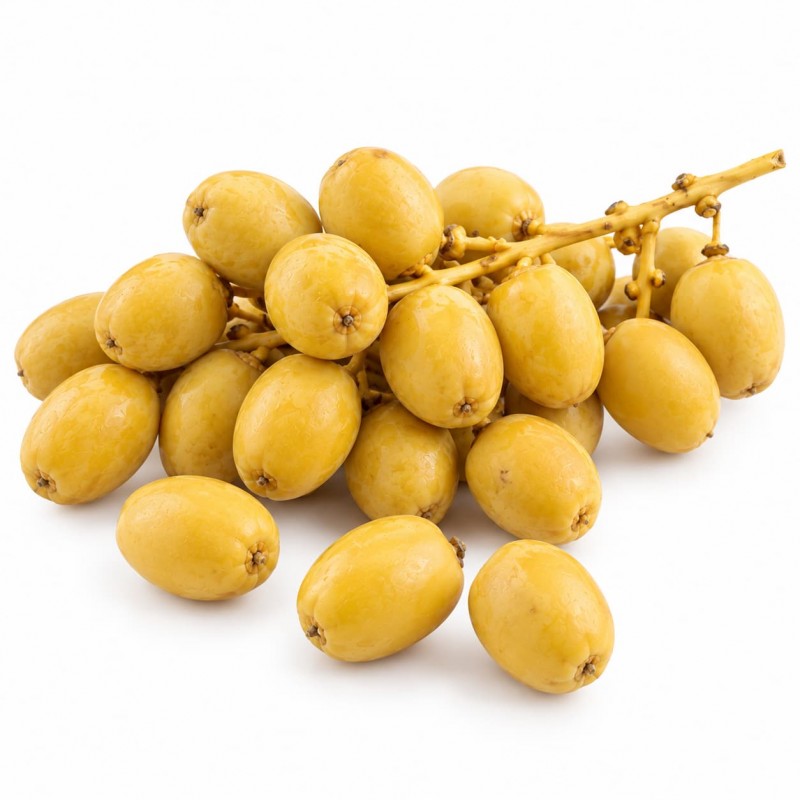
Khalal: the "partial" ripening of the date begins here. This stage is easily recognized because the fruit turns from green to a yellow color (due to flavones or flavonols, pigments of this color) or red (due to anthocyanins, other pigments) depending on the variety (we even have some pink ones) easily recognizable from a distance (in fact it is the image that almost all of us have of a palm tree with dates). At this stage the date can be edible in some varieties (such as Barhi - pronounced barji-) but its high tannin content (up to 6%) makes it very acidic, harsh and astringent to the palate. At this stage the date has a striking white flesh and very fibrous (keep in mind that the date is practically composed of cellulose fibers and sugars), is crunchy bite and if you have a little patience in the mouth, chewing a few seconds you can go from the initial astringency to a mild sugary flavor. A date that I call mini-barhi with these characteristics gives a lot of play on the plate for its yellowish showiness and in the mouth for its especially crunchy texture. A curiosity: this variety (like the Barhi) if it is frozen, the stage is changed to a more advanced one, so that after defrosting we have a very sweet flavor, total disappearance of astringency and change of color to honey color. Most of the sugars present in the Khalal state are of the sucrose type (sucrose is the common sugar and is formed by glucose + fructose) or of the reducing sugars type.
Rutab: means "soft" and is the stage of full maturity. The date turns a translucent amber color, its skin darkens to a more golden or brownish color (depending on the variety). Here the date begins to lose water, has lost tannins that are only 1% and is gaining in sugar content (sucrose) and especially those sugars belonging to the family of reducing sugars that reach up to 50% of its fresh weight. The concept of reducing sugar is biochemical and refers to the capacity of this type of sugar to associate with other elements of a different nature thanks to the fact that the reducing sugar has a free carbonyl group within its molecule. Reducing sugars are very present in sweet wines (in fact they are responsible for their sweetness), PX for example usually have a quantity of reducing sugars ranging between 100 and 500 mg/liter.
This is the stage in which the date presents the widest range of flavors, textures and aromas; it still retains its water and often secretes a kind of honey or molasses characteristic of this stage, the date is tender and very juicy, it is the true anthology of the product.
It is the most versatile stage, the date begins to have some wrinkles in the skin, can be touched, split, handled, cooked and also does not lose aroma or flavor in a few days if the cold chain is not broken. It also freezes perfectly although, yes, it loses part of the aroma (I estimate that 30% of it). At this stage it is only possible to taste it a few days after harvesting, this is the advantage of being produced in Spain. They are harvested from the palm tree and in 24 hours they are in the hands of any cook in our country.
Tamar: last stage of life of the date in branch. It has lost most of the water and only retains 10% of its content and has up to 80% of its weight of sugar (the rest of the weight is the bone), this is very close to what people know and what is on the market. The date is very wrinkled, drier, leathery and less juicy, although it is the sweetest, it is also the least aromatic. As advantages, this date keeps very well for months or even years if it is not moistened, but it is the driest bite. It is darker brown in color, almost black.
Properties and nutritional characteristics of dates
Much can be said about the nutritional characteristics of dates, but I would emphasize that they are very rich in carbohydrates, proteins and minerals: iron, potassium, calcium, sodium, magnesium, zinc, manganese, etc. They are also rich in vitamins A, C and many B vitamins. It has no cholesterol or any type of vegetable fats, that is why it is a food very consumed by athletes.