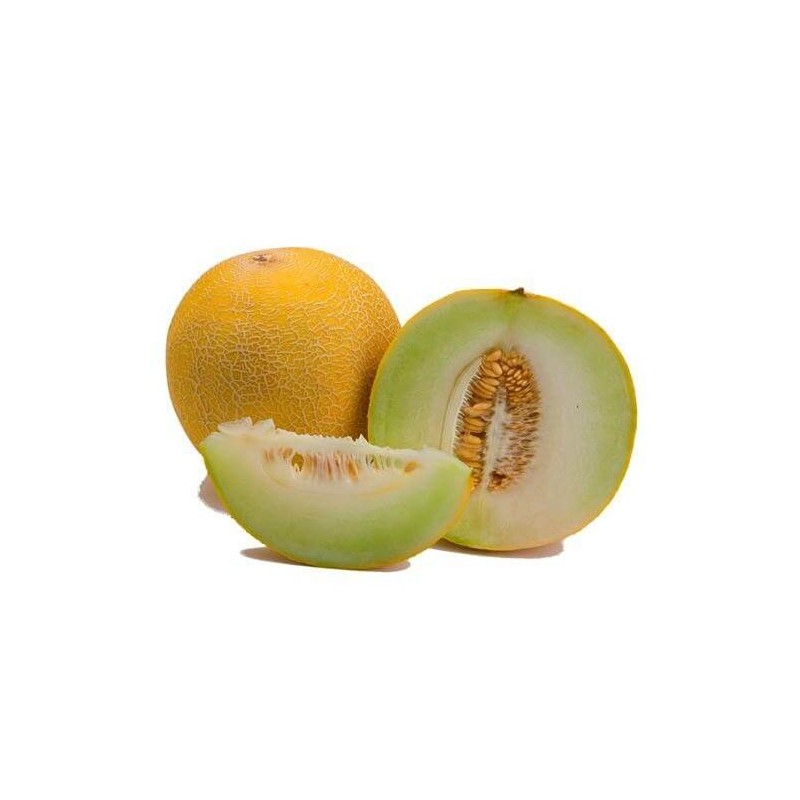
Weight (2.950 kg.- 2.65 kg.)
Weight (2.950 kg.- 2.65 kg.)
MELON
(Cucumis melo L.)
 It is not very clear of which are its origins, for some it is Africa, or India or Afghanistan and China. But what is certain is that there is evidence that it already existed in Ancient Egypt 2,400 years ago a.J.C. It was also consumed by the Romans in the third century and by the Muslims. In France it was not eaten until the 16th century. Columbus was the one who introduced it in America, in one of his trips.
Melon is a herbaceous, climbing plant of the Cucurbitaceae family. It needs tropical, dry climates, soils rich in organic matter, fluffy and well drained, so in Europe melons are imported from countries with tropical climates such as Brazil, Costa Rica, Israel, Morocco, Honduras, Ecuador,...
Spain is the main European country in producing them, followed by Holland and France. The Spanish areas where melons are grown are: Almería, Valencia, Castellón, Cuenca, Ciudad Real, Madrid, Elche (Alicante).
It is also effective for slimming diets.
|
|
Recipes
|
|
Melons contain 90% water, carbohydrates (sucrose and sucrose), few calories and little fiber. Melons contain:
Beneficial properties for:
Article of interest:
|
There are 850 species, classified by the following characteristics:
The best time to eat it is summer, until September.
|
Melon is a juicy and refreshing fruit, it is sweet and tasty. We should consume them all, because given its properties are advisable and necessary for all ages. With Melon, apart from preparing Fruit Salads or Macedonias, to eat it alone as any other fruit, it can also be eaten as a starter, hence the well-known dish of Melon with Ham, so nutritious and refreshing for the summer. The French also eat it as a starter. They have Port Melon, those round French melons. They remove the pips from the center and in the hole they put the port wine and eat it by spoonfuls. Suggested recipes:
|